I have had the good luck and privilege to have spent the last 18 months working with the UNDP Regional Innovation and Digital team (Bangkok) on a variety of digital transformation and reform agendas across South Asia and the Pacific. It has been an extraordinary learning experience, and I was also able to help make an impact in several programs. I’m thankful to Alex and Aafreen for taking me on, to Sriganesh and Giulio for wonderful collaboration, and to all the UNDP Country Offices I got to work with in Fiji, Palau, Malaysia, Bangladesh, Nepal, Bhutan and Sri Lanka. I also had the privilege of meeting and working with some extraordinary civil servants and political leaders from across the region, many with ambitious and truly transformative agendas. I am still particularly excited about the “AI Nation” work underway in Malaysia and the Gelephu Mindfulness City in Bhutan, both of which are national agendas that have the promise and ambition of economic and societal transformation.
I was involved in several missions in which I provided analysis, skills transference (life journeys, future states, agile delivery models, data, tech, AI, etc), a range of strategic workshops, recommendations, program support and advice on digital transformation initiatives, just to name a few. While most of the materials developed are internal to UNDP, I thought it would be nice to share (with permission) some resources and toolkits we built as repeatable frameworks, for others to benefit from. Enjoy!
| Resource | Intended outcome |
| The “Digital Transformation Archetypes” has four distinct and complementary outcomes governments seek when investing in “digital” agendas, each with clear aspirations, requisite capabilities, infrastructure, strategic considerations and program enablers. | Greater clarity in early discussions about government objectives and aspirations with digital investments, better planning and programming to achieve clear objectives, prioritisation of the platforms and capabilities required and a shared view of the future state. |
| I had the opportunity to advise on DPI initiatives in the region, which led to publishing a modern take on DPI, one that enables whole of nation uplift and outcomes, including some considerations for what is needed to address the promise and threats of AI. | To help governments plan beyond the limited (and limiting) idea that DPI is just digital identity, payments and data exchanges. I have seen initiatives promise all the benefits of digital transformation from just these platforms, which is misleading at best. |
| The AI Activate:Mitigate strategic primer (unbranded) is a resource to support governments in national AI policy, planning and national ambition setting. It includes strategic guidance on how to activate the benefits of AI at a national cross-sector level, while simultaneously managing national threats from misuse by bad actors. | Most AI guidance focuses on how to responsibly manage a particular instance of AI in a product, team or organisation. Few tend to look at national implications, so this resource was developed to support holistic national planning that both enables responsible adoption while actively mitigating harmful misuse. |
| A short paper that explains the difference between Service Design and Customer Experience, borrowed from a similar paper done by ESDC (Canada) | To help differentiate the two capabilities and demonstrate why both are needed, and they are complementary, not in competition. |
| The Civil Service LOOP Authorising Environment Assessment assesses the legal, operational, oversight and public authorities delegated to and exercised by civil servants and the civil service. Contact RID for more. | To understand the actual delegations held by the civil service and ensure there is sufficient decision making authority to be effective, impactful, humane and to sustain digital transformation after project closure. |
| An “digital pipeline accelerator model” for UNDP to support digital projects across the region, designed to bring human-centred and agile delivery methods and practices into the human development projects lifecycle. Please contact the RID team for more. | To de-risk and validate solution definition early and often, improve the speed and effectiveness of delivery through usability and adoption, and result in sustainable and ongoing digital delivery capabilities within relevant civil service Ministries. |
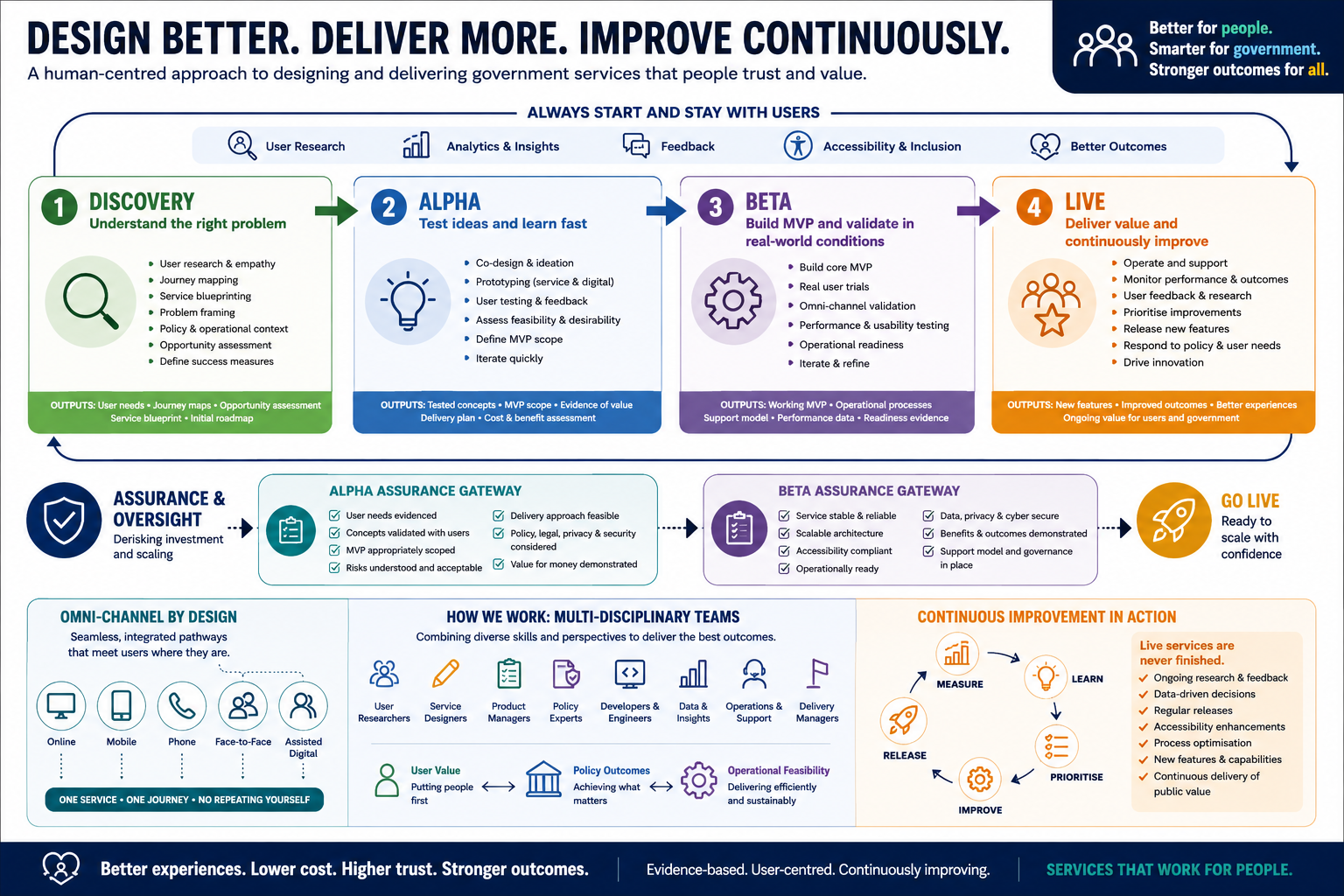
Below is a useful poster I created to help explain how to operationalise great service delivery in government 🙂
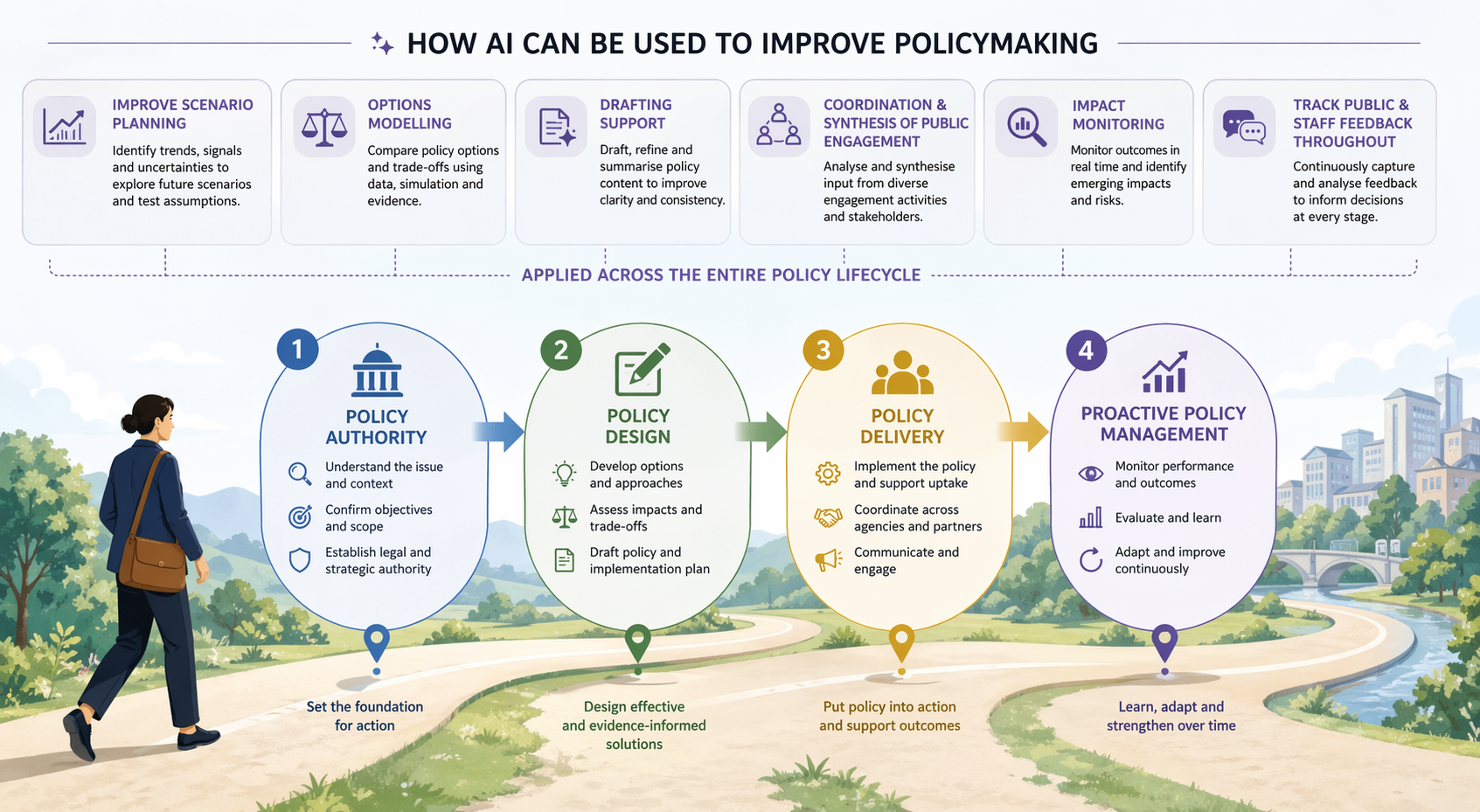
And here is an “AI for the policy journey datavis I made to help policymakers.
We also created briefing packs on one stop shops, on citizen outcomes from digital transformation, data, responsible use of AI in government, and loads of reviews and specific advice for the jurisdictions we worked with. For more, please get in touch with Alex Oprunenco and the RID team in Bangkok, who continue to do inspiring and impactful work across the region!
Next steps
While I greatly appreciated my time with the RID team at UNDP, and am thankful for all the lessons and opportunities to contribute to government reform and digital transformation efforts across the region, I knew I would always return to public service. Why? Because that is still the place where, for all the challenges and stress, I know I can have the greatest impact on the lives of people. When public institutions do well, everyone benefits. When they fail, everyone suffers (eventually). So I was thinking carefully about where I could contribute. My family and I recently moved to Darwin for a change in lifestyle, with a little encouragement 🙂 I wanted to contribute to the community I am living in, so I am delighted to say I will be joining the NT Government in a senior executive capacity, as the General Manager for Corporate and Shared Services at the Department of Children and Families. I know it will be a difficult portfolio with significant challenges, but I am hopeful I can do my part to help some of the most vulnerable members of our community to thrive. I’m joining a team of people who are passionate and dedicated to building stronger families and communities, and I look forward to bringing my skills, experience and energy to the mission.