A thank you and a return to service

After a short sabbatical from public service, I’m delighted to announce I’m returning to the Australian Public Service, where I intend to do my part in the extraordinary and once-in-a-generation reform agenda currently under way 😊

I have had wonderful opportunities over the past 23 years to work with and in the public sector, but it was 15 years ago that I really committed my professional life and career to public sector reform. I’ve since built up a broad and deep understanding of good public administration, while also acting as an enthusiastic pathfinder to shape modern, innovative and evidence-based approaches with adaptive operating models for more humane and participatory public policy, services and governance.

As part of this journey, and for those who want to understand my move to AWS, I decided to take a “public sector sabbatical” at the beginning of last year. I had three goals:

  1. to immerse myself in the challenges and opportunities of AI for government;
  2. to see whether it was possible to systemically help the tech sector be more mission-oriented and cognisant of the unique context of public service; and
  3. to explore ways to close the gap between policy design and delivery.

I was extremely lucky to be offered a role in a special team at Amazon Web Services (AWS) where I have not only been encouraged, but supported to explore these wicked problems, while also being able to share and learn along the way. It was great to work for a large tech company that is genuinely committed to helping their clients to grow and succeed, including the necessary internal capability and confidence in modern tech, mindsets and design/delivery methods. I also got to work with some extraordinary colleagues and a wonderfully visionary boss 😊 A huge thank you to Bruce Haefele, Amity Durham, Jithma Beneragama, Tim Bradley and Jodi Philips in the AWS Strategic Development team, along with all the other wonderful people I got to collaborate with. If you’re looking for AWS folk who really understand both gov and tech, Bruce and the team are great 😊 Thanks for the opportunity!

So I’m delighted to say I was able to do some great work on a whole range of projects while also making progress on all three of my professional goals:

  1. Trustworthy AI in government – I wrote a paper on building trustworthy AI systems in government, with a special focus on ADM (Automated Decision Making), with a wonderful range of reviewers and contributors with expertise on AI, public administration, privacy/law, ethical IT, social policy and more. It’s called the “A Trust Framework for Government Use of Artificial Intelligence and Automated Decision Making” and was followed by a range of talks, blogs and other thought leadership, which goes to the heart of ensuring any AI system isn’t just designed ethically, but it operated, continuously improved and monitored for real and unintended impacts. I also got to work with the wonderful AI expert, Natacha Fort, to create a comprehensive range of AI usage patterns, which really help to understand the different ways AI can be used, and their different risk and mitigation strategies for government.
  2. Mission/policy-oriented tech and delivery – After starting at AWS I learned about the Well-Architected Framework, which is the technical assurance mechanism adopted for all AWS systems globally. So we formed a diverse and international team to design an expansion pack, a “lens” with best practices and recommendations to ensure the special context and requirements of government – including the policy intention – are all included in the design, delivery and operating models for public sector systems/services. This provides a useful means for tech/IT teams to reach across the aisle to policy/business/regulatory teams and help close the gap between policy design and delivery. You can find the Gov Lens for the AWS Well-Architected and the Gov Lens is also available in the Well-Architected Tool for those wanting to use it for early definition/requirements gathering or to assure new systems.
  3. Adaptive policy management – My final goal was to explore and hopefully help establish a more adaptive, end-to-end and humane approach to policy design, decision making, delivery and continuous improvement. This journey led to an extraordinary collaboration with Prof Anna Zhu, an incredible researcher and lecturer at RMIT, which provided a platform for many areas of collaboration and progress. Anna and I brought together a diverse and wonderful group of research organisations, NGOs, government departments and companies that work with government, to submit an ARC Linkage Grant which was funded last month. The research project is called “The Intended and Unintended Impact of Policy for Adaptive Policy Management” and has two parts: 1) hypothesis-led research into how possible it is to monitor for and understand the patterns of human impact from policy changes using existing and cross sector data, with a reasonably high scientific and statistical confidence; and 2) to use the insights and learning from part one to inform a test-driven human impact measurement framework, a new adaptive policy cycle and operating model, and a range of policy infrastructure prototypes and demonstrators to enable end-to-end adaptive policy management. This collaboration has led to work through the year to explore the problems, opportunities and better/worse futures for policy management. I’ve written about some of our findings on the case for more adaptive policy management, and the case for shared and end-to-end policy infrastructure, and you can see sessions with Prof Catherine Althaus here and with Thea Snow here. Catherine, Thea, Suhit Anantula and I are trying to distill some of the work into a book over the coming year or so which will provide new policy frameworks and guidance for the whole sector 😊

My last reflection, is that I went to AWS because I wanted to continue working on public sector reform, even if from a position outside of service for a short spell, and I wanted to work specifically for an organisation that was aligned with my goal. AWS has, at its heart, a “customer obsession” which enables the company to systemically want to help clients to succeed and be highly capable, which is not always the case. So while some people were confused with my choice of sabbatical, hopefully the above helps to provide some context 😊

Now to the next chapter!

I’m very excited and humbled to announce I’ll soon be the Chief Data Officer in the Data and Economic Analysis Centre (DEAC) at the Department of Home Affairs. From all I can see, DEAC is one of the top data capabilities in the APS, and the portfolio does challenging and important work so I hope to bring my passions for great CCX service delivery (Client and Citizen/resident/refugee/migrant Experience), for humane and trustworthy end-to-end policy design and delivery, and of course, for data and evidence-driven decision making and continuous improvement, to the table. Perhaps we could also be a global exemplar for policy infrastructure 😉 I am delighted to be reporting to Deputy Secretary Sophie Sharpe, and to be in a position to contribute to the APS Reform in a department that is extremely committed to the agenda. I also look forward to rejoining the APS, especially with the benefits, lessons and experience from my time in the New Zealand, NSW and Canadian Governments.

Coming back to the APS feels like I’m coming home. It is all the more exciting for the once-in-a-generation changes happening at all levels to become a better public sector for everyone, and I intend to do my part to help.
The case for shared & end-to-end policy infrastructure

This post was written to follow The case for adaptive and end-to-end policy management, which explored the challenges and opportunities for reforming how we design, delivery, manage and continuously improve policies. This article explores the idea of “policy infrastructure” and why a rethink is needed to enable end-to-end policy management with impact monitoring and policy intent optimisation 🙂 I want to quickly acknowledge all the people who are contributing to this work, especially the folk involved in the Intended and Unintended Impact of Social Policy research project which is worth keeping an eye on 🙂

What is Policy Infrastructure? 

‘Policy infrastructure’ isn’t a term that’s often used in government, and yet we use and rely upon policy infrastructure every day. Policy infrastructure includes the data, tools and platforms that help us to analyse, design, model, implement, iterate, monitor and report on policies and policy interventions, throughout the entire policy lifecycle. Policy infrastructure necessarily includes an enormous range of software, data and platforms, because any one tool that tries to do it all never works 🙂 

Policy infrastructure is used to support both the design and development of new policies, as well as the delivery, ongoing management and evaluation of policy interventions. If we are to include all types of policies (constitution, legislation, regulation, Government objectives, operational requirements, department rules, whole of government requirements, etc), then there is a large and complex canvas of goals, success metrics, rules, requirements, eligibility criteria, formulae and requirements that need to be reflected in the policy infrastructure, relied upon by many. In the age of digitally-enabled governments, the scope of policy infrastructure also includes digital policy delivery and policy as code.

Unfortunately, there is currently no consistent or end-to-end approach to policy infrastructure – policy is created, implemented, measured, and amended by different actors, often working in isolation from each other. This inconsistency means there is no visibility of the whole policy journey by anyone involved, and a significant air gap between how policy is represented in modeling tools, and how policy is represented in the real world systems of service delivery government departments or regulated entities. This also creates a significant gap between the predicted impact policies are expected to have, and the broader impacts they have in reality. No modeling is perfect, and unexpected conflicts or variables will emerge as policy is implemented in the real world, in real time. For instance, social security and taxation legislation is extensively modeled in some policy agencies for the purpose of reform and budget analysis, but the same legislation is implemented separately (and sometimes differently) in delivery departments, where new variables exist such as system constraints, integration with other policy domains, operational rules and, of course, the intersection of cross-jurisdictional policies. Without access to the insights of the people tasked to deliver policy, policy makers and legislative/regulatory drafters may be unaware of the risks or conflicts, and unable to build in mitigations. In any case, when unintended conflicts or impacts inevitably emerge, there are limited ways to influence or iterate policy design.

Policy impact and outcomes are often not consistently measured or monitored across interventions. For instance, policy or evaluation teams might use administrative data to analyse policy impacts at a point in time, but delivery teams tend to monitor for system performance and customer experience. Imagine if all our services also enabled real time measurement of policy outcomes and broader quality of life or environmental impacts? It is possible to have a policy intervention like a public service or grant program might be considered successful in delivery (efficient, good user feedback, etc) that is simultaneously having an inverse policy impact, or creating unintended harms. So measuring and monitoring for both policy and human impact is a critical next step to build into policy infrastructure.

There is also no easy or accessible way to test your implementation against the authoritative policy or policies. No reference implementation of policy. No test suite (for example, a person/family with these characteristics should get these services, or a business with those characteristics has those obligations, etc).

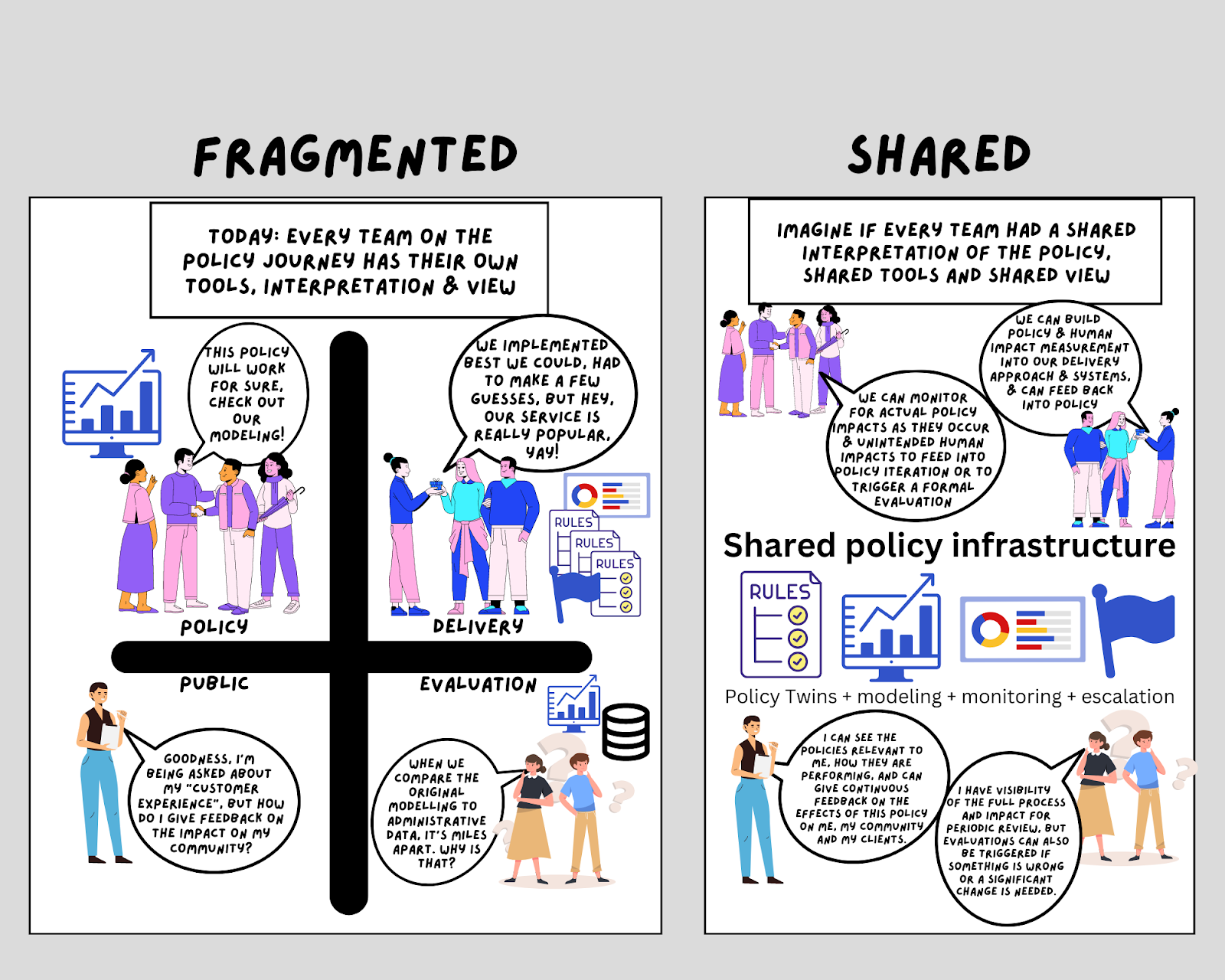
The final challenge in this space is the lack of shared or common policy infrastructure, because it exacerbates interpretation confusion and mutual incomprehension between policy design and policy delivery. The diagram below presents a high level view of the current state challenge of fragmented policy infrastructure, and contrasts it with the idea of shared policy infrastructure.


CC-BY: Pia Andrews, 2023

All actors involved in a given policy domain (including all relevant policy interventions) would ideally have access to the same shared policy infrastructure, the same digital representation of policy (“policy twins”), the same modeling and monitoring tools, feedback loops and perhaps even a shared “policy backlog”. Perhaps policy infrastructure could be shared across policy domains, or even open to the public, to facilitate transparency, alternative modeling, and testing policy options or proposed reforms in a wide variety of contexts to help identify potential or unintended consequences, and to maximise intended policy outcomes.

Policy Twins

Although not all policies are legislation or regulation, almost all government services and programs draw upon some legislation/regulation combined with myriad operational policies. The many and varied interpretations of these building blocks of public administration can make it hard to understand which rules are authoritative and which are operational. If we had reference implementations of policy as code (imagine we had api.legislation.gov.au), then we could remove the interpretation gap and have a better chance at identifying and remediating unintended policy issues as they arise.

A Policy Twin is simply the policy equivalent of a “Digital Twin”. Digital Twins provide a digital representation of spatial information like buildings, roads, water and gas pipes, which is used to model town planning, environmental impacts or other spatially driven analyses. A Policy Twin could be as simple as a digital representation of a policy, but could include legislation as code, relevant data (admin data, policy measures, lead and tail indicators, etc), modeling tools, impact monitoring and more. All the things you have seen emerge in the “Digital Twin” space, are possible with Policy Twins, and in fact some Digital Twins have already started including policy as code, such as the inclusion of resource management regulations in the Wellington City Council digital twin to model and display the impacts of changes to the building code. Here is a great article about how to turn building regulations into a Policy Twin. Inspiring stuff! 

The “Rules as Code” movement to has been growing over the past decade, including the use of policy as code to enable test-driven legislative and regulatory reform. Please see more on “Rules as Code” and the “Better Rules” approach to drafting in this explainer deck

Recently in Australia there was a VERY exciting announcement from GovCMS where they are now offering a “Rules as Code” enterprise capability to all GovCMS customers, providing greater ease of creating policy twins 🙂

Engaging with community infrastructure

Many communities run their own data, analysis and modeling infrastructure. Whether a not for profit NGO, an Indigenous/First Nations community or a town, the insights and intelligence that could help shape and inform policy options and change are worth understanding and building into a policy infrastructure model that is capable of respectfully interacting with such systems. This makes it necessary to consider federated architectural design, and ways of sharing insights and patterns across systems without sharing raw data. The progress made in verifiable claims/credentials, as well as in confidentialised computing provide some excellent opportunities for communities and governments to co-create meaningful and empowering policy twins. It also makes sense for government policy infrastructure to be available to communities for them to model, explore and test policy reform options.

Reverse engineering a future state policy journey

Proposals for reforming how policy is done are often, understandably, met with concerns at whether change would “slow things down”, but if we had a more end to end approach with policies designed for easy implementation, then the total time to realise policy intent could be dramatically shorter, even if it means a little more time up front. So a useful tactic might be to consider the whole “policy journey map”, like we do with user journey mapping.

What if we were to design a better, faster and end to end “policy journey map” to identify the necessary ingredients for modern, shared policy infrastructure? Below is an attempt intended to stimulate discussion and collaboration, as this is an emerging area that needs collective exploration with cross-disciplinary participation. 

Imagine for instance, being able to rapidly develop new legislation/regulation with reference implementations circulated for consultation and testing prior to being enacted by parliament (with the usual democratic rigour) and then available as code that same moment for rapid & consistent implementation by all the relevant policy consumers. It is possible, but only through transforming the policy/service continuum. When we make the rules of government authoritatively consumable by software, we dramatically improve the speed & consistency of delivery, with better policy outcomes and compliance.

Below is a high level “policy user journey” contrasting the current state approach to a more streamlined, test-driven and multi-disciplinary approach, which would dramatically reduce the time to impact.

CC-BY: Pia Andrews, 2023

With the high level journey map above, we can then explore and propose the shared and common policy infrastructure we need to support the journey end to end, as per below.


CC-BY: Pia Andrews, 2023

The very early-thinking, draft model above includes the following elements, aligned to the broad temporal phases of policy delivery:

To support test-driven policy ideation (pink):

  • Public engagement tools to explore, co-design & test policy options, both initially (new policies) & ongoing (continuous improvement to policies and policy interventions).
  • Linked and integrated admin data for research, policy modelling & patterns monitoring, best hosted by an independent, highly trusted entity, like the ABS.
  • Case law and gazettes as a utility to use for analysis and to test new ideas.
  • Publicly available modeling tools for testing and exploring policy change.

To support test-driven policy options design, development & drafting (purple):

  • Consistently applied Human Impact Measurement Framework used across government, including for new policy proposals and for monitoring.
  • Public repository to share policy tools, government models, measurement frameworks, synthetic population data, etc.

To support the Parliamentary processes, publishing and visibility (aqua):

  • A linked data representation of the administrative orders to automate reporting, accountability, auditing, security, access & to streamline MOGs.
  • Publicly available Policy as code (intended outcomes, legislation, models, defined target group) available at api.legislation.gov.au
  • Policy catalogue where all operational and Government policies can be discovered, along with measures and transparent reporting of progress. 

To support policy intervention design & implementation (delivery) (green):

  • A “Citizen’s ledger” to record all decisions with traceable explanations, for auditing & citizen access
  • Policy test suite to validate legality of system outputs in gov services & regulated entities.

To support policy compliance, iteration & improvement over time (yellow):

  • Open Feedback loops for public and staff about policies & services, to drive continuous improvement and to identify and mitigate harm.
  • Continuous monitoring of policy & human impacts, including dark patterns & quality of life indicators, alongside usual systems monitoring, to ensure adverse impacts are identified early and often.
  • Escalation and policy iteration mechanisms to ensure issues detected are acted upon at portfolio and whole of gov levels.

A shift to “CI/CD Policy”?

It’s clear when you start trying to imagine a more collaborative, adaptive, humane, iterative and test driven approach to policy management, that a lot of the techniques and methods from product management, CI/CD (Continuous Integration / Continuous Development) pipelines, service design and agile become useful. So why not reuse some of the infrastructure, tools, methods and platforms that we have adopted in service reforms over the last decade to help modernise policy delivery?

We could have CI/CD policy pipelines, policy feedback loops, product management for policy, policy monitoring and measurement tools, policy escalation frameworks, policy test suites, policy twins, and public policy engagement/codesign platforms. Perhaps each policy would have a policy manager who owns the end to end outcome realisation (rather than the current baton passing from design to delivery teams), and perhaps each policy intervention could have its own “policy product owner” who owns the delivery of that intervention, but works in concert with other interventions to the policy manager to make sure interventions are effective, complementary and continuously adapting to change and impact? We don’t need to start from scratch here, but we do need to design a good policy journey, so that we can meaningfully leverage what is available, but also identify where there are gaps to fill. 

What do you think?

What do you see as the opportunities and challenges for policy infrastructure? What would your ideal policy journey map look like? Which portfolios would have the right mandate and systemic motivations to run which parts of the concept model above (note, not which department is best functionally/capabilities placed, but which department is best aligned/motivated 🙂)? What other tools, data and platforms would you include? Do you have any examples to share? 

Please share your thoughts and any examples and let’s all take a strategic and proactive approach to modernising our policy infrastructure, so we can be more adaptive and effective in delivering policy and public outcomes.